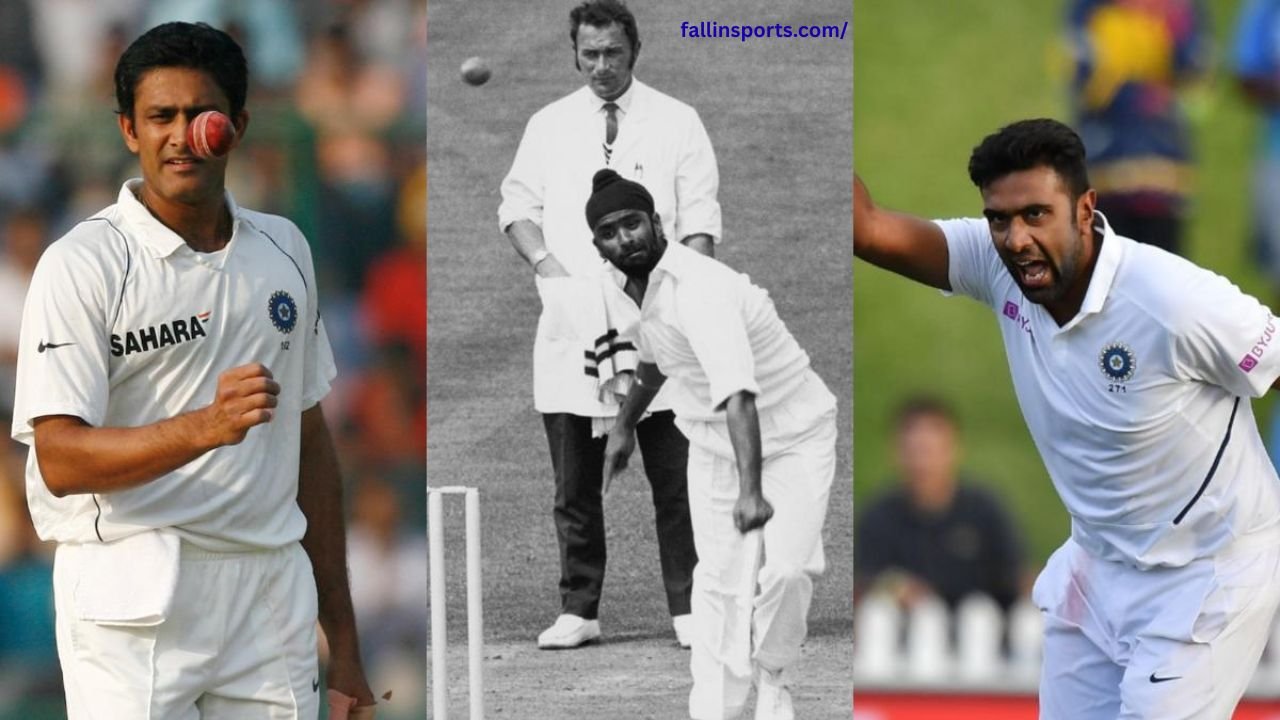
From the artistry of Bishan Singh Bedi and Erapalli Prasanna to the extraordinary wicket-taking ability of Anil Kumble, and from Harbhajan Singh’s famous doosra to Ravichandran Ashwin’s modern-day variations, Indian spin bowling has evolved dramatically over the decades.
Spin has always had a special place in Indian cricket. The country’s pitches, climate and cricketing culture have helped produce generations of outstanding spinners. But India’s greatest spinners were not successful simply because they played on turning pitches. Many of them achieved remarkable results overseas as well.
Anil Kumble finished his international career with 619 Test wickets and 337 ODI wickets, making him India’s leading wicket-taker in both formats. He is also one of only two bowlers in Test history to take all 10 wickets in an innings.
Ravichandran Ashwin finished his international career with 765 wickets across formats, including 537 Test wickets. He also became only the second Indian bowler after Kumble to reach 500 Test wickets.
But statistics are only part of the story.
A great spinner needs control, variation, patience, intelligence and the ability to deceive batsmen. Some bowlers dominated with flight and turn, while others relied on accuracy, bounce or subtle changes of pace.
So, who are the 10 greatest Indian spinners of all time?
Here is our ranking.
1. Anil Kumble
When discussing the greatest Indian spinner of all time, Anil Kumble is almost impossible to leave at No. 1.
The legendary leg-spinner is India’s greatest wicket-taker in both Test and ODI cricket.
Kumble finished his Test career with 619 wickets in 132 matches and his ODI career with 337 wickets in 269 matches. His combined international wicket tally reached 956.
What made Kumble unique was that he was not a traditional leg-spinner who relied primarily on enormous turn.
Instead, he bowled with exceptional accuracy, pace and bounce. His quicker deliveries were particularly difficult for batsmen to handle.
His most famous achievement came against Pakistan in Delhi in 1999.
Kumble took 10 wickets for 74 runs in an innings, becoming only the second bowler in Test history at the time to dismiss every batsman in an opposition innings.
It remains one of the most iconic bowling performances in cricket history.
Kumble also had an outstanding overseas record. He regularly bowled long spells in Australia, England, South Africa and the West Indies, proving that his effectiveness was not restricted to Indian pitches.
His longevity was another remarkable feature.
He represented India for 18 years and became a leader of the team, eventually captaining India in Test cricket.
Kumble’s combination of wicket-taking, accuracy, durability and leadership puts him at the top of this list.
Key achievement: 619 Test wickets
Specialty: Leg-spin, accuracy and bounce
Career: 1990–2008
2. Ravichandran Ashwin
Ravichandran Ashwin is arguably the most technically sophisticated Indian spinner of the modern era.
The Tamil Nadu off-spinner brought an enormous variety of deliveries into international cricket.
His traditional off-break was only the beginning. He developed variations including the carrom ball, changes of pace, different angles and tactical adjustments depending on the batsman.
Ashwin finished his international career with 765 wickets, second only to Kumble among Indian bowlers. His Test tally of 537 wickets is also second only to Kumble’s 619.
He reached 500 Test wickets in just 98 matches, becoming the second-fastest bowler in Test history to reach the milestone.
But Ashwin’s value goes beyond his wicket tally.
He was also a genuine all-rounder.
Ashwin scored six Test centuries and became the only player in Test history with more than five hundreds and more than 500 wickets.
His performances in India were particularly dominant.
He repeatedly destroyed batting lineups on turning pitches, but he also produced important spells overseas.
His tactical intelligence was one of his greatest strengths.
Ashwin constantly studied batsmen and adjusted his bowling accordingly. He could attack the stumps, create pressure outside off stump or change his pace to force mistakes.
He also developed into one of India’s most influential cricketers of the 2010s and 2020s.
With 37 five-wicket hauls and eight 10-wicket match hauls in Tests, his statistical record is extraordinary.
For modern Indian cricket, Ashwin’s legacy is enormous.
Key achievement: 537 Test wickets
Specialty: Off-spin, variations and tactical intelligence
Career: 2010–2024
3. Harbhajan Singh
Harbhajan Singh was one of India’s most successful spinners during the early 2000s.
The off-spinner became a major international star during India’s famous Test series against Australia in 2001.
Playing at home, Harbhajan produced one of the greatest bowling performances by an Indian spinner.
He took 32 wickets in the three-Test series, helping India defeat Australia after Australia had entered the series on a remarkable winning run.
His bowling was aggressive, and his ability to extract bounce and turn made him a constant threat.
Harbhajan also became famous for his doosra, a delivery that moved in the opposite direction to a conventional off-break.
He finished his Test career with 417 wickets, while his ODI career produced 269 wickets. ICC records place him among India’s leading Test wicket-takers.
His international career also included major limited-overs success.
Harbhajan was part of India’s 2007 T20 World Cup-winning team and the 2011 ODI World Cup-winning squad.
One of his biggest strengths was his ability to attack.
Rather than simply containing batsmen, Harbhajan often looked for wickets and was willing to flight the ball and challenge the batter.
His career lasted more than 15 years, making him one of India’s longest-serving elite spinners.
Key achievement: 417 Test wickets
Specialty: Off-spin and attacking bowling
Career: 1998–2015
4. Bishan Singh Bedi
Before Kumble, Harbhajan and Ashwin, Indian spin bowling was defined by a group of extraordinary slow bowlers.
At the heart of that era was Bishan Singh Bedi.
Bedi was a left-arm orthodox spinner famous for his beautiful bowling action, control and ability to deceive batsmen through flight.
He was not simply a defensive bowler.
Bedi understood how to tempt batsmen into attacking and then use subtle changes in trajectory and spin to create mistakes.
He finished his Test career with 266 wickets in 67 matches.
His bowling style was based on elegance rather than brute force.
The legendary Indian spin quartet of the 1960s and 1970s included Bedi, Erapalli Prasanna, Bhagwat Chandrasekhar and Srinivasa Venkataraghavan.
Bedi was often regarded as the leader of that group.
He also enjoyed considerable success overseas.
During India’s 1971 tour of England, Bedi was an important member of the bowling attack, while his ability to bowl long spells made him a valuable Test bowler.
His figures from that era demonstrate the incredible workload spinners were expected to handle. In India’s 1974 England tour, for example, Bedi bowled more than 600 overs.
Bedi’s influence extends beyond his statistics.
He represented an era when spin bowling was treated almost like an art form.
Key achievement: 266 Test wickets
Specialty: Left-arm orthodox spin and flight
Career: 1966–1979
5. Erapalli Prasanna
Erapalli Prasanna was one of the finest off-spinners India has ever produced.
He was another member of India’s famous spin quartet and was renowned for his ability to deceive batsmen through flight and changes in trajectory.
Prasanna was particularly dangerous when he could attack the batsman from close to the stumps.
His ability to give the ball air and encourage batsmen to drive created opportunities for catches around the bat.
He finished with 189 Test wickets in 49 matches.
His numbers may look modest compared with modern bowlers, but the context of his era is important.
India played far fewer Tests than modern teams, and spinners often operated in an environment where maintaining pressure for long periods was more important than simply chasing wickets.
Prasanna was particularly effective on turning pitches but was also capable of performing overseas.
His performances in Australia and England demonstrated his class.
During India’s 1971 tour of England, he was part of a legendary spin attack that helped India secure their first Test series victory in England. His statistics from that tour show the enormous workload carried by Indian spinners.
Prasanna’s bowling was a combination of intelligence, patience and exceptional control.
Key achievement: 189 Test wickets
Specialty: Classical off-spin and flight
Career: 1962–1978
6. Bhagwat Chandrasekhar
Bhagwat Chandrasekhar was one of the most unusual and exciting spinners in Indian cricket history.
A leg-spinner with a distinctive action, Chandrasekhar could produce enormous pace and bounce from a relatively short run-up.
His bowling was particularly dangerous because batsmen could never be completely certain what was coming.
Some deliveries turned sharply.
Others skidded through.
His pace meant that he could surprise batsmen who were expecting conventional slow leg-spin.
Chandrasekhar finished his Test career with 242 wickets in 58 matches.
One of his greatest performances came during India’s historic 1971 tour of England.
At The Oval, he produced a remarkable bowling performance that helped India secure their first Test victory in England.
His ability to perform overseas was a major part of his legacy.
Chandrasekhar’s career also demonstrated the diversity of Indian spin bowling.
While Bedi relied on elegance and Prasanna on classical off-spin, Chandrasekhar brought unpredictability and aggression.
He was one of those bowlers who could completely change the momentum of a match within a few overs.
His partnership with Bedi, Prasanna and Venkataraghavan created one of the most famous spin attacks in cricket history.
Key achievement: 242 Test wickets
Specialty: Leg-spin, pace and variation
Career: 1964–1979
7. Ravindra Jadeja
Ravindra Jadeja represents the modern generation of Indian spin bowling.
Unlike many players on this list, Jadeja is also a world-class all-rounder and elite fielder.
His left-arm orthodox spin has become one of India’s most reliable weapons.
Jadeja does not always rely on enormous turn.
Instead, he uses accuracy, speed, bounce and relentless pressure.
He is particularly effective on pitches where the ball stays low or where batsmen struggle to score against accurate spin.
His Test wicket tally has passed the 300 mark, placing him among India’s leading wicket-takers. ICC records have highlighted Jadeja’s progress up India’s all-time Test wicket list.
His batting makes him even more valuable.
Jadeja has scored multiple Test centuries and has repeatedly rescued India from difficult situations.
His fielding is another major advantage.
His athleticism, throwing arm and catching ability make him one of the best fielders of his generation.
This means a captain gets three valuable skills from a single player.
Jadeja’s partnership with Ashwin was particularly important during India’s dominance at home in Test cricket.
The two spinners complemented each other perfectly: Ashwin offered variations and tactical creativity, while Jadeja provided accuracy, pace and relentless pressure.
Key achievement: 300+ Test wickets
Specialty: Left-arm spin, accuracy and all-round ability
Career: 2009–present
8. Venkataraghavan
Srinivasa Venkataraghavan, commonly known as Venkat, was another important member of India’s famous spin quartet.
He was a tall off-spinner who relied heavily on accuracy and subtle variations.
Venkat’s bowling was particularly effective when he could bowl long spells and force batsmen into mistakes.
He finished his Test career with 156 wickets in 57 matches.
His statistics may not immediately stand out next to Kumble or Ashwin, but his importance to Indian cricket should not be underestimated.
He played alongside Bedi, Prasanna and Chandrasekhar during one of India’s most famous eras of spin bowling.
He also captained India and later became a respected umpire.
His bowling was based on discipline.
Rather than constantly searching for spectacular turn, Venkat could bowl accurately for hours and allow pressure to create wickets.
During India’s 1971 tour of England, he bowled more than 590 overs across the series.
That workload gives some idea of the role he played in India’s bowling attack.
Key achievement: 156 Test wickets
Specialty: Accuracy and classical off-spin
Career: 1965–1983
9. Dilip Doshi
Dilip Doshi is one of the more underrated names on this list.
The left-arm spinner made his international debut relatively late, but he quickly established himself as a reliable Test bowler.
Doshi played 33 Tests for India and took 114 wickets.
He also claimed more than 100 wickets in ODI cricket.
His left-arm orthodox bowling was based on accuracy and subtle variations.
He was particularly effective at building pressure and forcing batsmen to take risks.
Doshi’s international career lasted from 1979 to 1983, meaning he had to compete for recognition during a period when India had already produced several legendary spinners.
That makes his achievements even more impressive.
He was also an excellent first-class bowler, collecting a huge number of wickets during his domestic career.
Doshi may not have had the longevity of Kumble or Ashwin, but his impact during his international career was significant.
He deserves recognition as one of India’s finest left-arm spinners.
Key achievement: 114 Test wickets
Specialty: Left-arm orthodox spin and control
Career: 1979–1983
10. Shivlal Yadav
Shivlal Yadav completes our top 10.
The Hyderabad off-spinner represented India during the 1980s and played an important role during a transitional period for Indian cricket.
He finished with 102 Test wickets in 35 matches.
Yadav was known for his accuracy and ability to bowl long spells.
His role was often about controlling the middle overs and creating pressure rather than producing spectacular turn.
He also contributed useful runs lower down the batting order.
Yadav’s career came between two major generations of Indian cricket.
The legendary quartet had already retired, while Kumble had not yet emerged as India’s next great spin-bowling superstar.
That meant Yadav had to operate during a period when Indian cricket was searching for its next generation of spin bowlers.
Although his statistics are modest compared with some names above him, reaching 100 Test wickets remains a significant achievement.
His career deserves recognition whenever India’s greatest spinners are discussed.
Key achievement: 102 Test wickets
Specialty: Accurate off-spin
Career: 1980–1986
Honorable Mentions
India’s history of spin bowling is so rich that several outstanding players narrowly miss the top 10.
Subhash Gupte is one of the biggest omissions. The leg-spinner was considered one of the finest Indian bowlers of his generation and finished with 149 Test wickets.
Padmakar Shivalkar was another outstanding left-arm spinner who dominated domestic cricket and represented India in Test cricket.
Venkatapathy Raju also deserves recognition. The left-arm spinner played 28 Tests and 53 ODIs for India.
More recently, Kuldeep Yadav has established himself as one of India’s most exciting wrist-spinners.
Kuldeep’s ability to turn the ball sharply from the left-arm wrist-spin angle makes him a different type of bowler from Jadeja and Ashwin.
If his career continues at its current level for several more years, he could eventually enter discussions about India’s all-time great spinners.
What Makes Indian Spinners So Successful?
India’s success with spin bowling is not accidental.
Several factors have contributed to the country’s extraordinary history of spin.
1. Domestic Pitches
Indian domestic cricket has traditionally provided extensive opportunities for spinners to develop their skills.
Learning to bowl long spells and exploit turning surfaces helps young bowlers develop patience.
2. Variety
India has produced almost every type of spin bowler.
There have been:
- Leg-spinners
- Off-spinners
- Left-arm orthodox spinners
- Wrist-spinners
- Mystery spinners
This variety has allowed India to adapt to different conditions.
3. Patience
Test spin bowling requires patience.
A spinner may have to bowl dozens of overs before getting a breakthrough.
Indian cricket has traditionally valued bowlers who can maintain pressure for long periods.
4. Tactical Intelligence
Modern Indian spinners have become increasingly analytical.
Ashwin is an excellent example of a bowler who studies individual batsmen and constantly changes his approach.
5. Batting Ability
Modern Indian spinners such as Ashwin and Jadeja also contribute significantly with the bat.
This makes it easier for captains to select two specialist spinners in the same playing XI.
Kumble vs Ashwin: Who Is India’s Greatest Spinner?
The debate between Anil Kumble and Ravichandran Ashwin is likely to continue for years.
Kumble has the larger Test wicket tally: 619 compared with Ashwin’s 537.
Kumble also played 132 Tests compared with Ashwin’s 106.
Ashwin, however, reached several milestones much faster and became one of the most successful spin bowlers of the modern era.
He also contributed far more with the bat, scoring six Test centuries.
Kumble’s greatest advantage is longevity and overseas success.
Ashwin’s greatest advantage is variety and tactical sophistication.
Ultimately, choosing between them depends on what you value most.
For overall career achievement, Kumble gets the edge.
For modern spin-bowling innovation, Ashwin has an extremely strong case.
Final Thoughts
India’s relationship with spin bowling is one of the great stories of international cricket.
From the elegant left-arm spin of Bishan Singh Bedi to the classical off-spin of Erapalli Prasanna, the unpredictable leg-spin of Bhagwat Chandrasekhar and the accuracy of Srinivasa Venkataraghavan, India’s famous spin quartet established a remarkable tradition.
Then came Anil Kumble, who combined relentless accuracy with extraordinary longevity and became India’s greatest wicket-taker.
Harbhajan Singh carried India’s spin tradition into the modern era, while Ravichandran Ashwin took off-spin to a new level through tactical innovation and variations.
Today, Ravindra Jadeja continues that tradition, while Kuldeep Yadav represents the exciting next generation of Indian wrist-spin.
The numbers tell only part of the story.
A great spinner is not simply someone who takes wickets. The greatest spinners change matches. They create pressure, deceive batsmen, control scoring and produce breakthroughs when their team needs them most.
That is exactly what India’s greatest spinners have done for generations